
Risk Management
Basic Policy
Taikisha has upheld the corporate philosophy of "Establish a company which can continuously grow and contribute to society." Guided by this philosophy, Taikisha is working to reduce material risks and minimize risks before they materialize, in order to continue with businesses and achieve their sustainable development. From the Taikisha Group's integrated perspective, the Risk Management Committee performs such tasks as assessing the risk level (degree of importance) of each risk, selecting risks that need to be addressed, and formulating a policy to reduce risks. In addition, to prepare for the occurrence of a crisis such as a disaster, an accident or an incident, Taikisha has established a crisis management system and formulated a Business Continuity Plan (BCP).
Risk Management System
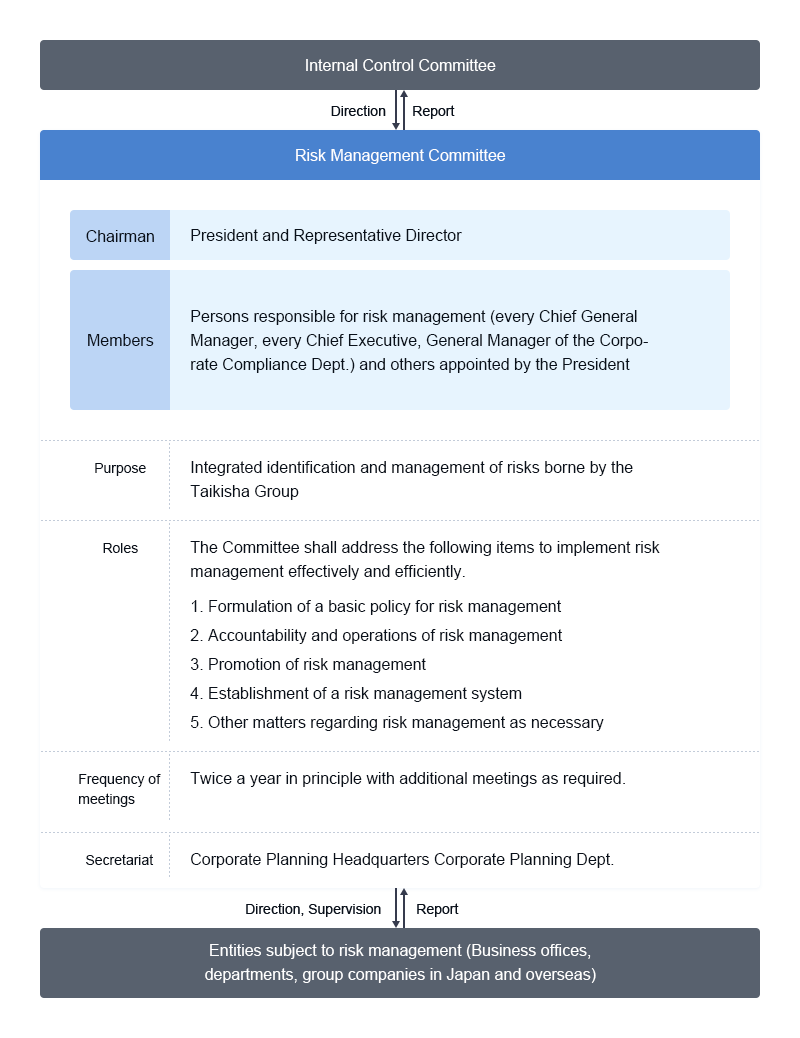
Taikisha, in accordance with the Risk Management Rules that have been in place, has established the Risk Management Committee, chaired by the President and Representative Director to implement effective, efficient and integrated risk management in the Taikisha Group. The Risk Management Committee meets twice a year and as needed to establish and ensure awareness and compliance with the Company’s basic policies, responsibility structure, and operations for group-wide risk management.
Regarding risks associated with operations assigned to each department, such as quality control, safety control, compliance, and finance, each responsible department extracts risks, selects risks that need to be addressed on a priority basis after determining the risk level (degree of importance) in consideration of “impact on management” and “frequency of occurrence,” and then develops priority management policies and goals to be reported to the Risk Management Committee.
The Risk Management Committee discusses the risk level assessment and priority management policies and goals of each risk from a group-wide and integrated perspective, and formulates the basic policy. Each responsible department monitors the status of execution of action plans and reports the results to the Risk Management Committee. The Chairman of the Risk Management Committee puts together the status of group-wide risk management and reports it to the Board of Directors twice a year after discussing the matter at the Internal Control Committee.
In FY2024, the Risk Management Committee held comprehensive discussions on company-wide risks, including those related to human resources supporting the global growth strategy and strategic investments.
Major Risks and Remedial Measures
Risk of fluctuations in private sector capital investment
- Content
- Decrease in orders received due to deterioration of environment for receiving orders, fall in capital investment by clients and change in investment fields
- Remedial Policy and Measures
-
- Broaden the client base by enhancing sales system
- Accelerate the development of technologies that will change customers’ production facilities
- Tap new markets and new clients in painting field based on automation technology
Risk associated with large-scale natural disasters
- Content
- Losses, direct physical and human damage, and impact on customers’ business activities and economic conditions caused by natural disasters such as earthquakes, tsunamis, storms and flooding, and global epidemics of infectious diseases, etc.
- Remedial Policy and Measures
-
- Establish basic policies for crisis management and develop a crisis management system
- In the event of a crisis, implement crisis response measures according to the level of impact (classified into three levels)
Risk related to management and control of overseas businesses and overseas affiliates
- Content
- Deterioration in business performance due to overseas affiliates’ failure to fulfill business plan and risk of uncollectibility of receivables attributable to unexpected amendment of local laws and regulations, political instability, etc.
- Remedial Policy and Measures
-
- Proactively collect information on political, economic, legal and regulatory information at overseas sites
- Reduce risks through hedging based on forward exchange contracts, etc.
- Strengthen credit management through screening before accepting orders
- Make overseas affiliates’ governance system more sophisticated
Risk concerning technological development
- Content
- Inability to differentiate from other companies in terms of technology, resulting in loss of sales opportunities and a decline in customer confidence and corporate reputation
- Remedial Policy and Measures
-
- Solve social issues through the development and demonstration of environmental impact reduction and automation technologies
- Expand the breadth of communication by utilizing the Research and Development Center and the R&D satellite facility
- Strengthen Group-wide activities through the use of digital technologies
- Promotion of innovative technology development through integration with academic institutions/start-up companies
Human resource-related risks in project execution
- Content
- Delays in the development of engineers, shortage of skilled and experienced engineers, decrease in the total working hours of engineering employees due to the application of regulations for upper limits on overtime work in the construction industry effective from April 2024, and stagnation in securing and training key human resources for overseas business development
- Remedial Policy and Measures
-
- Streamline on-site work and level the workload by promoting front-loading of on-site operations
- Improve basic technological capabilities through training and promote on-site practical education
- Create an appealing workplace and secure human resources by conducting work style reform and taking measures against long working hours
- Introduce global human resource system, secure and train key human resources and promote localization at overseas sites
- Clearly indicate the health management promotion system to maintain and promote mental and physical health of employees, and plan and implement health measures
Risk concerning legal compliance
- Content
- Violation of Antimonopoly Act, violation of Construction Business Act, violation of Labor Standards Act, etc.
- Remedial Policy and Measures
-
- Conduct compliance education programs on an ongoing basis as well as follow-up activities
- Develop a culture and mechanism that prevent rules from being violated
Risk of serious accident or defects, etc. due to poor quality
- Content
- Accident in construction stage, loss of social credibility due to quality defects, etc., claims for damages including lawsuits from customers, etc.
- Remedial Policy and Measures
-
- Enhance safety management system
- Conduct a review on construction management system and promote application of IT
- Establish the Engineering Headquarters to strengthen systems and activities ensuring technical and quality standards across the company
Risk of fluctuations in material prices and unit labor costs
- Content
- Rising procurement prices for construction materials and rising unit labor costs due to low birthrate, aging population, and shortage of workers
- Remedial Policy and Measures
-
- Reflect appropriate costs by region into the contract amount at the time of receiving an order
- Hedge risk against price fluctuations in contracts
Risk of confidential information leakage
- Content
- Leakage of confidential information such as personal information and customer information through cyber-attacks and data exfiltration
- Remedial Policy and Measures
-
- Develop and implement a roadmap for risk mitigation measures based on the results of IT security diagnostics
- Establish a response system for IT incidents (Taikisha’s version of Computer Security Incident Response Team, or CSIRT) and promote employee education
Risk concerning climate change
- Content
- Loss of customers due to inability to adapt to customer needs, a decline in competitiveness due to delays in the development of technologies, cost increases due to the introduction of carbon taxes, lower labor productivity due to a rise in average temperature, etc.
- Remedial Policy and Measures
-
- Develop low-carbon construction technologies and systems
- Expand the construction of energy saving-equipment
- Promote mechanization and automation
Risk concerning human rights
- Content
- Additional costs arising for corrective measures and remedies, a decline in social credibility, and the resulting stagnation in business activities, in cases where negative impacts on human rights occur in business activities, or situations that promote such impacts
- Remedial Policy and Measures
-
- Establish the Taikisha Group’s Human Rights Policy as a standard for human rights
- Implement human rights due diligence
- Conduct educational and awareness-raising activities for officers and employees
Information Security
In order to protect customer, business partner, and personal information from leaks and other risks, we are working to strengthen our information security measures.
Management system
We are strengthening the information management system across the entire Taikisha Group by establishing the Information Security Rules, which include detailed rules for all employees and persons in charge of IT system/facility development respectively, as well as guidelines and other rules based on the privacy policy.
To minimize the spread of damage in the event of an IT incident, we have formulated the IT Incident Response Policy and established a response system in the event of an IT incident (Taikisha’s version of CSIRT), enabling swift and appropriate responses.
Measures
To address the cybersecurity threats that are becoming more diversified and sophisticated on a daily basis, we review the information security risks and conduct initiatives aimed at risk mitigation based on the zero trust approach.
Education
We are working to raise awareness of information security among Group employees by regularly implementing e-learning programs and training against targeted phishing email attacks.
Crisis Management System
Taikisha has established the Basic Policy for Crisis Management and built the crisis management system to prepare for the occurrence of unforeseen disasters, accidents and incidents in Japan and overseas.
In the event of a crisis, Taikisha classifies crises into three response levels depending on the severity of impact on human lives and business continuity, and implement crisis response measures according to each response level. The Chief Executive of the Administrative Management Headquarters assumes the position of Chairman of the Crisis Management Committee. If it is decided that a particularly serious crisis has occurred, the President and Representative Director takes command as the Head of the Crisis Task Force.
For Taikisha employees deployed overseas and those on overseas business travel to be able to engage in business activities without concern, Taikisha has formulated the “Overseas Security Response Manual” to help employees prevent and avoid risks of crimes and terrorism and the “Overseas Crisis Management Guidelines (main vol.),” which stipulates the actions to be taken by Taikisha’s headquarters and overseas affiliates in the event of an occurrence of a crisis.
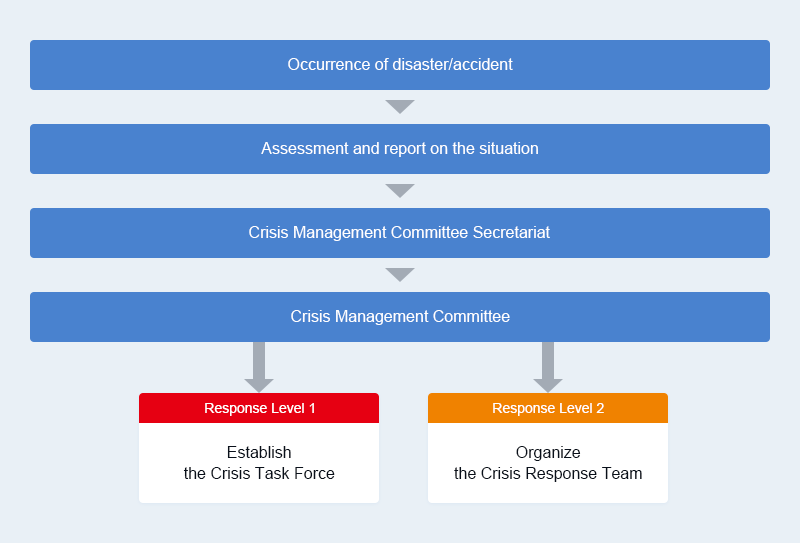 Diagram of Crisis Management System
Business Continuity Plan (BCP)
To ensure the safety of human life and implement necessary measures for business continuity during emergencies such as large-scale natural disasters, terrorism, civil unrest, war, kidnapping, or threats, each Group company has developed a business continuity plan (BCP) based on the Basic Policy for Business Continuity Planning.
At domestic business offices, Taikisha conducts training, such as training on wireless phone communication, taking inventories and checking expiration dates on emergency food stocks. In addition, Taikisha carries out training on how to handle the safety confirmation system. With regard to the safety of employees, Taikisha has organized a company-wide self-defense firefighter team and conducts training activities. In addition to evacuation drills and training sessions provided by the self-defense firefighter team, Taikisha holds training sessions on AED and first-aid rescue to train employees.
In addition, based on the Pandemic Preparedness Business Plan formulated from experience in responding to COVID-19, the Company is establishing a system to respond accurately and promptly in order to take the utmost care for respecting human life and continue our business while placing the highest priority on securing safety even in the event of a pandemic.
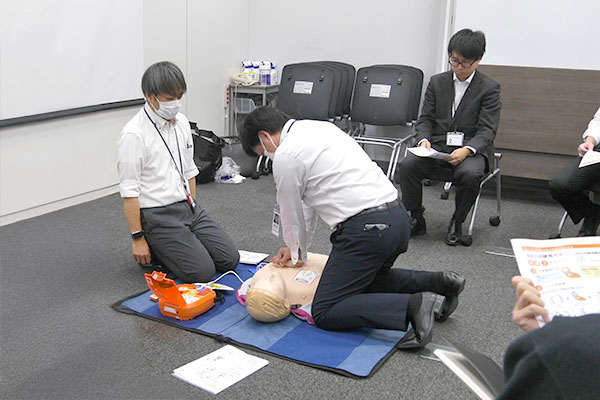 AED and first-aid rescue training session